Planning Ethernet drops, WiFi access points, cameras, phones, or low-voltage wiring for a Phoenix business? Use this guide before you ask for a quote.
Network cabling is easy to overlook because it hides in walls, ceilings, racks, and patch panels. But when it is planned poorly, everything that depends on it feels the pain: slow WiFi, dead data ports, camera issues, phone problems, messy troubleshooting, and expensive rework.
This guide is for Phoenix business owners, office managers, IT teams, and general contractors who need a practical way to scope a cabling job. If you are ready to talk with a local team, TekDash's network cabling installation in Phoenix is the right place to start.
Network Cabling Installation in Phoenix Checklist
Before you compare bids, make sure each contractor is pricing the same job. A clean scope should answer these questions:
How many data drops are needed now?
Where will future desks, access points, cameras, or printers go?
Will cables terminate in a rack, wall cabinet, or existing network closet?
Will the installer label both ends of every cable?
Will they test each run and give you results?
Will they patch the cables neatly into a patch panel?
Will they protect ceiling, wall, and firestop requirements?
If a quote skips these basics, it may look cheaper at first but cost more later.
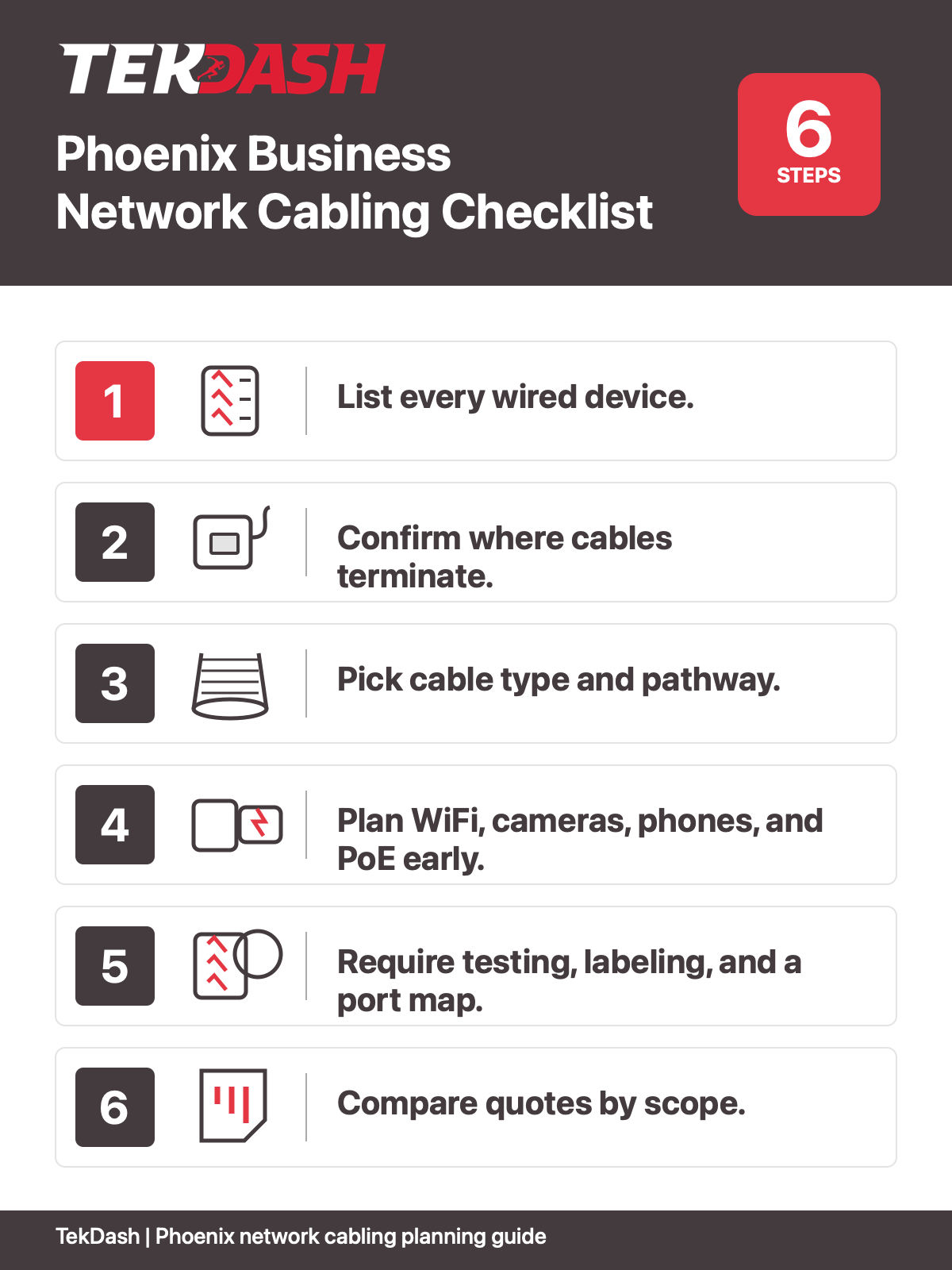
A quick Phoenix business network cabling checklist to use before requesting a quote.
Use the Network Cabling Scope Planner
A scope planner helps you walk the space before the installer arrives. Use it to mark rooms, devices, port counts, and notes. It also helps your IT provider and contractor talk about the same layout.
Phoenix network cabling planning tool
Build a cleaner cabling scope before you ask for a quote
Use this worksheet during your walkthrough. Add up the items below, then ask the installer how they will test, label, and document each cable run.
Item to count
Your count
Notes
Desks or workstations
_____
Plan one or more data drops per desk.
Printers, copiers, or shared devices
_____
Mark where each device will live.
WiFi access points
_____
Most business APs should have wired backhaul.
Security cameras
_____
Confirm PoE, mounting height, and cable path.
VoIP phones, POS, kiosks, or counters
_____
Count powered devices separately.
Future spare capacity
+ 20-25%
Leave room for moves, adds, and changes.
Installer questions:
Where will every cable terminate?
Will every run be tested and labeled at both ends?
Will we receive a port map or clear handoff notes?
What cable type and pathway do you recommend, and why?
What is excluded from the scope, such as drywall repair, conduit, trenching, lift rental, or equipment configuration?
1. Start With the Devices, Not the Cable
Do not start by asking, "How many cables do I need?" Start by listing what needs a connection.
Common devices to count
Desktop computers
VoIP phones
Printers and copiers
WiFi access points
Security cameras
Access control panels
Time clocks
Point-of-sale systems
Conference room displays
Network equipment and uplinks
Once you know the devices, you can plan drops, cable paths, rack space, and switch ports.
2. Check What Is Already There
Many offices already have old cables above the ceiling or inside walls. Some are usable. Some are not. Before adding new cable, ask the installer to inspect what exists.
What to look for
Old unlabeled cables
Damaged jacks
Loose wall plates
Messy patch panels
Cables that do not test cleanly
Runs that go nowhere
Network closets with poor airflow or power
A good installer should not blindly add cable without checking whether the current system can support the new work.
3. Ask Where the Cables Will End
Every cable needs a clear start and end point. Most business cabling runs from a wall jack, ceiling device, or equipment location back to a network closet, rack, or wall cabinet.
Ask how the installer will handle:
Patch panels
Rack or cabinet layout
Cable management
Labels
Service loops
Separation from electrical wiring
Future expansion
Clean termination makes future troubleshooting much easier. Messy termination turns every small change into a guessing game.
What Network Cabling Installation in Phoenix Should Include
A business cabling job should include more than pulling cable from one point to another. At minimum, your scope should cover planning, cable routing, termination, labeling, and testing.
Termination into jacks, patch panels, or equipment
Labels on both ends
Cable testing
Cleanup and handoff notes
For Phoenix buildings, it is also smart to plan around heat, ceiling access, tenant improvement schedules, and coordination with other trades.
5. Plan WiFi Access Points Early
WiFi problems are often cabling problems in disguise. If access points are placed in weak locations or connected to poor cable runs, the wireless network will struggle.
Plan WiFi access point locations before the cable pull. Think about coverage, ceiling height, walls, user density, and where power-over-Ethernet switches will sit. For dedicated wireless buildouts, see TekDash's WiFi access point installation in Phoenix page.
6. Plan Cameras, Access Control, and Phones as Low-Voltage Wiring
Network cabling often overlaps with low-voltage systems. Cameras, door controllers, VoIP phones, and access points may all depend on clean data cabling and PoE switches.
If your project includes multiple systems, make sure the cabling scope includes all of them. TekDash also supports low-voltage wiring scopes in Phoenix when network, security, and communications wiring need to be coordinated.
7. Require Testing, Labels, and a Port Map
This is one of the easiest ways to separate a serious cabling quote from a weak one.
Ask for:
A label on each wall plate or device end
A matching label at the patch panel
Test results for each cable run
A simple port map or handoff document
These items save time when someone needs to move a desk, troubleshoot a port, add a switch, or find a failed cable later.
8. Compare Quotes by Scope, Not Just Price
Two cabling quotes can look similar and still include very different work. One may include patch panels, labels, testing, and cleanup. Another may only include pulling cable and installing jacks.
Ask each installer these questions
What cable type are you using?
Are patch panels included?
Are wall plates and jacks included?
Will every cable be tested?
Will both ends be labeled?
Will you provide a port map?
Who handles ceiling access, conduit, or firestop work?
What happens if a cable fails testing?
The cheapest quote is not always the lowest-cost choice if it creates rework.
9. Know When Fiber Belongs in the Plan
Most office drops use copper Ethernet cable, but fiber may make sense for longer runs, backbone links, building-to-building connections, MDF-to-IDF links, or high-bandwidth uplinks.
If your project includes long-distance links or multiple network closets, ask whether fiber optic cabling should be part of the plan.
Questions to Ask Before Network Cabling Installation in Phoenix
Use these questions during your walkthrough or estimate call:
How many drops do we need today?
How many drops should we plan for later?
Where will the rack or cabinet go?
Do we need WiFi access point cabling?
Do we need camera or access control cabling?
Will any run need fiber?
Will the installer test and label every cable?
Will we receive a port map after the work is done?
If the project supports business-critical systems, also review basic security planning. CISA's small business cybersecurity resource hub is a helpful starting point for thinking about the broader network environment.
Final Thought
Good cabling is quiet. It does its job every day without getting attention. Bad cabling gets noticed fast.
If you are planning an office move, tenant improvement, network refresh, camera project, or WiFi upgrade, build the cabling scope before the work starts. For local commercial projects, TekDash's structured cabling services in Phoenix page can help you choose the right next step.
FAQs About Network Cabling Services in Phoenix
What is network cabling installation?
Network cabling installation is the planning, pulling, terminating, labeling, and testing of cables that connect business devices to a network. It can include office data drops, WiFi access point cabling, camera cabling, phone cabling, and rack or patch panel work.
What are the most common types of network cables?
Most business projects use Cat6 or Cat6A copper cable for Ethernet connections. Fiber optic cable may be used for longer runs, building links, backbone connections, or higher bandwidth needs.
Is network cabling the same as structured cabling?
They are closely related. Network cabling usually refers to the physical cables that connect network devices. Structured cabling is the organized system of cables, racks, patch panels, labels, and pathways that makes the network easier to manage.
What should I know before requesting a network cabling quote?
Know how many devices need wired connections, where the network closet or rack will go, whether you need WiFi access point or camera cabling, and whether the installer will include testing, labels, and a port map.
Does TekDash provide network cabling installation in Phoenix?
Yes. TekDash supports Phoenix-area businesses with network cabling, structured cabling, data cabling, WiFi access point cabling, fiber optic cabling, and low-voltage wiring. The best starting point is the local Phoenix service page linked earlier in this guide.
Can TekDash work with our IT provider or general contractor?
Yes. TekDash can coordinate with internal IT teams, managed IT providers, general contractors, and other trades so the cabling scope lines up with the larger project.